

Behind the stories: The lives of student journalists


When James Madison drafted the U.S Constitution in 1787, there was one profession granted guaranteed protection from governmental interference and oversight. That profession is journalism.
Freedom of the press has long been one of the United States’ hallmarks. Newsrooms were intended to keep power in check, expose corruption and uncover truth regardless of the mounting pressures against journalists.
Since this country’s inception, freedom of the press has been seen as an integral part of society, especially on college campuses across the nation. In 1908, that freedom led the University of Missouri to found the world’s first school of journalism that offered a formal college degree.
Before degrees and college classes arrived on the scene in Missouri, the history of journalism on campuses revolved around student publications. A mere 12 years after Madison drafted the Constitution, The Dartmouth opened on the grounds of Dartmouth College in 1799, becoming America’s oldest college publication.
In the 227 years that followed The Dartmouth’s inception, approximately 1,104 student publications began work across the United States. Each newspaper fills an important need in a country that began with freedom of the press but has strayed from traditional journalistic values.
Journalism classes teach students that the perfect role of journalism in a society is to be a “watchdog” for the community it covers. With the polarizing political and partisan landscape that has only intensified in recent years, now students are shown media bias charts to show which publications hit the mark, and others that fall short of the goal.
That is where student publications come in. College newspapers have the unique capability of serving a population that the journalists themselves understand: fellow students. While bigger publications target larger state-wide or nation-wide stories, student news organizations are able to communicate the news their peers need to know on a more intimate level.
College publications offer a unique opportunity for students to get real-world journalism experience but also deal with the hardships as well. From the one-of-a-kind challenges to the prospect of everyday students providing news coverage to populations that need it makes student journalism something to protect.
One large component of student media is the fact that not all students involved at a college publication are studying journalism. Many college papers do not require prior experience and accept students from all kinds of majors. From business to education and dance to science, the opportunity to do journalism at a college publication is afforded to everyone.
Gray Nocjar, editor-in-chief of The Observer and a junior electrical engineering major with minors in energy studies and journalism at Notre Dame, began his journalism path at a club fair when he got to college. Although his main areas of study – outside of the journalism minor – may not directly correlate to a communications field, Nocjar is driven by a will to tell stories.
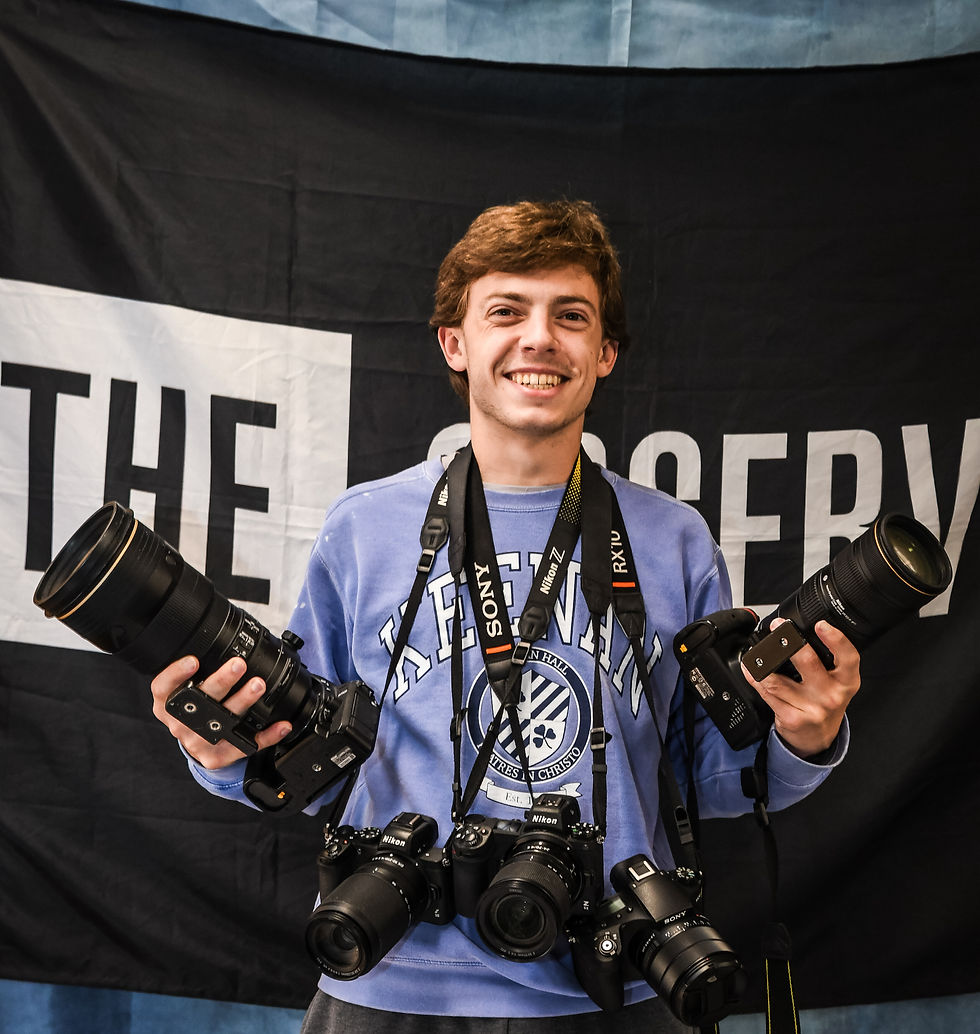
“I had no journalism experience,” Nocjar said. “I didn’t do any journalism in high school, but I know I wanted to tell the Notre Dame story. I was a Notre Dame nut. I did a lot of history projects which involved The Observer, and so once I got here, this was the first place that I stopped.”
After a conversation with the editor-in-chief at the time, Nocjar began work in three of The Observer’s departments: news, sports and photo. After spending a semester being a jack-of-all trades, Nocjar stepped up into the photo editor role, all while still writing here and there.
Now in his junior year, Nojar’s journey led him to Notre Dame to study electrical engineering, but he found a passion on the side along the way through The Observer.
“Honestly, legacy is a very important part of my life,” Nocjar said. “Where I left my legacy on campus was something I thought about a lot as a freshman … and I ended up deciding that it was going to be The Observer.”
Stories such as Nocjar’s are not uncommon at student publications around the country. In fact, in the 2022 American Journalist Study, numbers showed that in professional newsrooms a mere 60.6% of journalists with a degree studied some form of communications. Narrowing those numbers down to only journalism majors would see the percent drop to 45.1% of those with a degree.
With students coming from different background and areas of study, the content of these college publications provides a diverse look at their campuses. A plethora of differing experiences can be a breath of fresh air to break out of the norm of traditional journalism. With many of these student newspapers considered as “learning labs”, those participating are encouraged to break the mold and try different things.
Abby Godsen, a senior at IU Indianapolis studying applied information and data sciences also while working towards her master’s degree in library sciences, is the editor-in-chief of The Campus Citizen. Like Nocjar her degree is not solely tied to the journalism profession, but she recognized the importance of student media early on.

“I remember in eighth grade we had members from our high school newspaper come and talk to us about how awesome of an experience [working for the paper] was,” Godsen said. “I was immediately drawn to how cool it seemed.”
Godsen’s interest in student media stemmed from a larger calling inside herself. Studying data sciences, Godsen is drawn to information accessibility to provide people the access and tools to learn and grow. Joining student media fit into that passion, leading her to join Crown Point’s high school’s newspaper.
“For me, it kind of seemed like a natural progression that I would want to also create content and community resources and help educate others,” Godsen said. “After meeting some of the staff members I was like, ‘you know what? I could do this’… And that’s kind of how I got started.”
Godsen’s time at Crown Point’s student publication had her wear many hats. From redesigning the regular newspaper to a news magazine, remapping content strategies and diving into different photojournalism opportunities, Godsen was faced with an evolving landscape beyond the print.
As her time at Crown Point ended and Godsen began her journey at IU Indianapolis, she was uncertain if she wanted to continue with student media. After the first meeting though, she was drawn back in.
“I went to the first meeting and [it was like] ‘Okay I’m hooked, I’m back’,” Godsen said.
Godsen’s reentry into student media – this time at the college level – opened her eyes to real life journalism. Covering stories for The Campus Citizen meant giving students information they needed, not only about IU Indianapolis but the city of Indianapolis as well. Even in a city with professional journalists and a few different publications, Godsen and The Campus Citizen made waves.
“This is kind of my first experience with real journalism that really, really reaches people,” Godsen said. “I’ve talked to people at Mirror Indy and sometimes they’ll look at our stuff and be like ‘Okay, well, I don’t have to cover this story because Campus Citizen already covered it’.”
Godsen’s work at The Campus Citizen and other student journalists’ work across the nation showcases the immense need for student publications, especially in areas that are classified as “news deserts”. In areas that lack news coverage that provide critical information to its residents, student publications have been stepping in to provide the news needed for the community even beyond campus.
One of the student publications that has stepped up has been The Indiana Daily Student (IDS) out of Indiana University in Bloomington. Founded in 1867, the IDS has provided news to the Bloomington area and Monroe County for 159 years. While Bloomington has news organizations such as The Bloomingtonian and The Bloomington Herald-Times, the IDS has evolved into one of the leading news sources in the area despite being a student publication.
Mia Hilkowitz and Andrew Miller both lead the IDS as co-editor-in-chief, leading a staff of 60 consistent contributing writers, photographers, designers and social media producers. As one of the most renowned student publications not only in the state of Indiana but also the country, the IDS also has a marketing team and professional staff members to assist with the paper’s operations.

“We are a full-blown newsroom,” Hilkowitz said. “Often we are producing more coverage and professional grade journalism.”
That professional grade journalism has provided Indiana University and the surrounding Bloomington community with much-needed news in times when professional newspapers are on the decline. According to Northwestern University’s State of Local News Outlook, from 2005 to 2025 the United States saw over 3,200 local U.S newspapers close down. Employment at newspapers has seen a whopping 70% decrease at the same time, citing the need for student publications to step up and cover those areas.
“I interned at The Harold Times, the USA Today owned newspaper [in Bloomington],” Miller said. “It is now, I believe, about five people that work there.”
Miller’s comments are not an implication on The Harold Times, but rather one on the state of news media across the country. With the transition into a digital age, many publications are feeling the squeeze as the industry evolves. People now get their news from social media, while politicians campaign for the downfall of legacy media – including newspapers. This distrust in legacy media coupled with dropping advertising revenue for publications forces newspapers to close down, only widening the media desert.
This is why the continuation of student journalism in these areas – such as how the IDS operates in Bloomington – is important to keep people informed.
“The IDS feels to me like more of a professional newsroom,” Miller said. “It’s simultaneously a learning lab where it’s the best place you’re going to be able to learn the skills that journalism demands. Through that route of memorization, it’s also the best newsroom in the county.”
Both journalism students at IU, Hilkowitz and Miller have been able to perfect their craft over the years they have worked at the IDS. Despite the promising prospects that student media offers those coming into college, there are challenges and hardships lurking around every corner. As professional newspapers falter around these campuses, student publications try to find ways to stay alive in funding crises, staff shortages and even oppression from administrators at the universities.
The IDS saw the latter firsthand, when the IU Media School fired Jim Rodenbush, who was the director of student media at the time. After IU’s attempt to censor the IDS from publishing any news other than information about Homecoming, Rodenbush came to the defense of the publication and was terminated for a “lack of leadership and ability to work in alignment with the University’s direction for the Student Media Plan”.
Even before Rodenbush’s termination, the IDS had experienced financial issues that had caused the IU Media School to step in as financial guarantors of the publication. Although the paper was partially funded by the Media School, the IDS’ Student Media Charter stated that “final content decisions and responsibility rest with duly appointed student editors and managers”.
After Rodenbush’s firing, IU went further and fully cut the IDS’ print newspaper that had been distributed around campus and Bloomington for decades. The storm that followed tested Hilkowitz and Miller’s resolve, but both stayed firm in their belief in the IDS and student media.
“All hell broke loose,” Hilkowitz said. “The public saw straight through it as well. We had hundreds of alumni, thousands even [starting to] call IU out, emailing them [and] pulling funding. We got so much support. We also got a lot of media coverage, which I think helped as well.”
Beyond the public, other media organizations started to pick up the story as well. What started as local news at publications such as The Bloomington Herald-Times and IndyStar, bloomed into a national news story covered by NBC, The New York Times, The Associated Press and many more.
The outpouring of support and donors speaking with their wallets caused IU to backtrack, allowing the IDS to continue printing as planned through the end of the year. What began as a nightmare began to show signs of light at the end of the tunnel, with a little help from the Indiana football team.
“[The reinstatement of print] allowed us to print our ‘Welcome Back’ edition and continue to get information out to people,” Hilkowitz said. “But it also helped us make a lot of money recently because our football team won the national championship and we ran a commemorative page one … we made $160,000 off that print edition.”
Another problem that plagues college newsrooms across the country can be the small staff sizes. Abigail Berry, editor-in-chief of the Indiana Statesman and elementary education major at Indiana State, has dealt with the pressures of running a student publication with limited staff of 27 people.

Inspired to get into journalism by a love for grammar and a general interest before coming to college, Berry began as a copy editor but has now made her way to be editor-in-chief. One of her main challenges in charge of the Statesman – like many other college publications around the nation with smaller staff sizes – has been filling pages. Despite the hardships, Berry and the Statesman innovated other ways to fill pages and provide content to the community.
“We have different social media shows … and our graphic designer has made us some really nice house ads that we’ll try to fill space with first,” Berry said. “We have a subscription to the Tribune Content Agency (TNS). So, if we ever need to fill space, we just pull a story from there that we find relevant. We hate doing that, but sometimes we just can’t fill the space any other way.”
While the frustration of needing to use other content to fill pages is there, Berry recognizes the need for student journalism on college campuses. Not only does it keep the campus population informed, but it serves as an opportunity to give back to the community and bring light to issues that may not be talked about.
“I recently did a story on period poverty, which is why women don’t have access to period products,” Berry said. “That’s not something that is really talked about anywhere, so it’s just cool when people reach out to student journalists because maybe they weren’t able to with the bigger, professional journalists.”
Throughout the many triumphs and trials that college journalists go through to provide news for their community, the passion for student journalism does not die. At the end of the day, it is the dedication of these students who juggle classes, relationships, commitments and jobs to serve and inform a community.
“Student journalism has the unique perspective of being run by students who are in this really strange transitionary period of their life,” Godsen said. “We’re all here with the same end goal of making sure that people feel seen and heard, and that the stories that need to get told, get told.”
While the press has evolved throughout the history of the United States; truth always finds a way of coming to light. Every day at college campuses around the country, there are students from all walks of life striving for the same thing: to uncover truth and inform a community. Every story, column, multimedia package a photo story documents a piece of history from each corner of the country, all done by students with a will to persevere.
“If you lose the newspapers, you will no longer understand the way that the world is going to be working,” Nocjar said. “If people want to understand … what’s actually going on, then we need to be supported. They need to be around, or that will die.”


Comments